

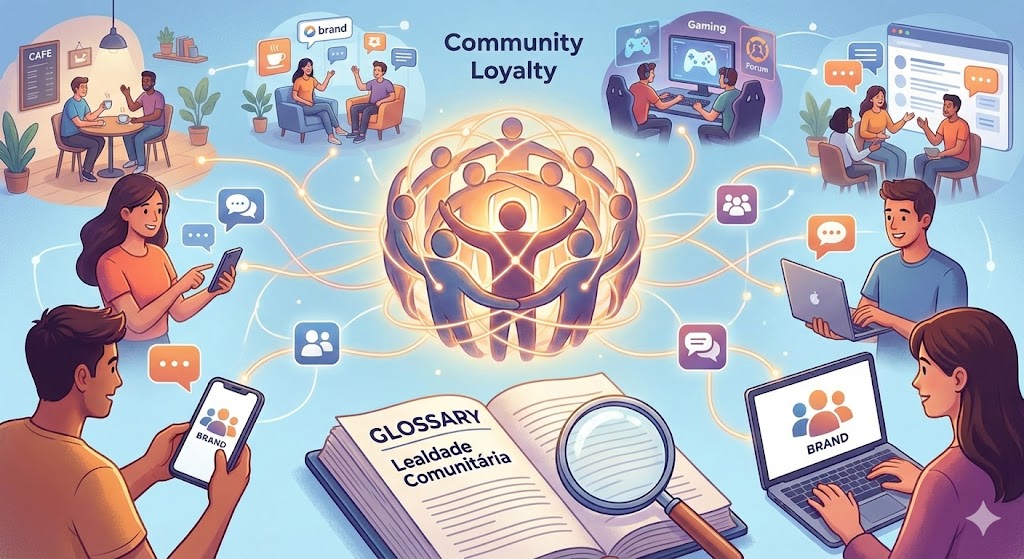
Community Loyalty is an advanced stage of customer loyalty where the consumer's primary bond shifts from being solely with the purchased product or service to being with the network of people who consume that brand.
In this model, the product acts as a “passport” or “ticket” that grants access to an exclusive group, forum, Discord server, or social ecosystem. The customer remains loyal to the brand not necessarily because it offers the lowest price or the best technical functionality, but because leaving the brand would mean losing their social connections, status, and sense of belonging.
The Psychology: From “Buyer” to “Member”
Community Loyalty is based on the fundamental human need for belonging. Unlike traditional loyalty programs (based on points and discounts), which are transactional and rational, community loyalty is emotional and identity-based.
The customer thinks: “I use brand X because I am the type of person who interacts with other people who use X”.
The Social Switching Cost
The great strength of this strategy is creating an extremely high exit barrier. If a competitor launches a better or cheaper product, the customer thinks twice before switching, as the change would imply “abandoning the tribe.”.
- Example: An iPhone user might even prefer a competitor's hardware but does not switch to avoid losing integration with iMessage and family and friends' sharing groups.
Where Community Loyalty Happens
Today, the “digital squares” where this loyalty is built include:
- Proprietary Forums and Reddit: Spaces for technical discussion, peer support, and fan theories.
- Closed Groups (WhatsApp/Telegram/Facebook): Intimate communities where the brand often does not even intervene, letting users lead.
- Discord Servers: Very common in games and software (SaaS), where interaction is in real-time.
- Events and Rituals: Exclusive in-person or virtual meetings for members.
Comparison: Traditional Loyalty vs. Community Loyalty
| The Fulfillment (Delivery): | Traditional Loyalty (Transactional) | Community Loyalty (Relational) |
| Ship-from-DC | The Product / Price | The People / The Tribe |
| Mechanism | Points Accumulation / Cashback | Interaction / Discussion / Mutual Aid |
| Motivation | Saving money | Feeling part of something / Status |
| Relationship | Brand ↔ Customer (Unidirectional) | Customer ↔ Customer (Multidirectional) |
| Retention | Fragile (whoever offers the biggest discount wins) | Solid (emotional bonds difficult to break) |
Benefits for the Brand
1. Reduction of Support Costs
In strong communities, experienced users themselves answer newcomers' questions (Peer-to-Peer Support). This drastically reduces the need for a huge support team.
2. Brand Advocacy
Community members not only buy; they defend the brand against external criticism. They act as “evangelists,” bringing in new members organically (reducing Customer Acquisition Cost – CAC).
3. Feedback and Co-creation
The community becomes a real-time research lab. Brands can test ideas and gather honest feedback from their most engaged users before launching products to the mass market.
Classic Examples
- Harley-Davidson: Perhaps the oldest example. You buy the motorcycle to participate in clubs and group rides.
- LEGO: The adult community (AFOLs – Adult Fans of Lego) creates projects, votes on new sets, and sustains the brand beyond the child audience.
- Notion and No-Code Software: Users create templates, share productivity tips, and help each other build complex systems, making it difficult to abandon the tool.
Community-Led Growth
Community-Led Growth (CLG) is a Go-to-Market (GTM) strategy where the user community acts as the primary engine for a business's acquisition, retention, and expansion.
Unlike traditional marketing, which focuses on “pushing” the company's message to the customer, CLG creates an environment where customers attract new customers. The community functions as a value multiplier: users create content, provide technical support to each other, share templates and evangelize the brand, creating a virtuous cycle of organic growth that reduces dependence on paid advertising.
The Mechanism: From “Funnel” to “Flywheel”
In the traditional model, marketing operates as a Funnel (money is put in at the top to get customers out at the bottom). In CLG, the model is a Flywheel (a wheel that, once in motion, gains its own inertia).
- Attraction: A user encounters a problem and finds the solution not in an advertisement, but in a forum, video, or template created by another community user.
- Engagement: The new user joins the community to learn. They receive immediate value through peer-to-peer help.
- Adoption: Feeling welcomed and empowered, they purchase the product or subscribe to the service.
- Advocacy: The user becomes an expert and begins helping newcomers, restarting the cycle.
Pillars of CLG
For community-led growth to work, three elements are essential:
- User-Generated Content (UGC): The brand does not need to create all tutorials. The community creates videos, reviews, and usage guides that index on Google and bring organic traffic.
- Peer-to-Peer Connection: The platform (whether Slack, Discord, or a Forum) must facilitate conversation among users, without constant brand interference.
- Recognition: Gamification systems (badges, levels, “Ambassador” status) that reward the most active and helpful members.
Comparison: Sales-Led vs. Product-Led vs. Community-Led
Modern companies often combine these models, but it is important to understand the distinction:
| Model | Sales-Led Growth (SLG) | Product-Led Growth (PLG) | Community-Led Growth (CLG) |
| Primary Driver | Sales Team | The Product Itself | The User Network |
| Ship-from-DC | Close deals | User Experience (UX) | Relationship and Belonging |
| Acquisition | Outbound / Cold Call | Free Trial / Freemium | Word of Mouth / Fan Content |
| Support | Account Manager | Self-service / FAQ | Peer-to-Peer (User Helps User) |
| Example | Oracle, SAP | Dropbox, Slack (early days) | Notion, Figma, Peloton |
"I have it in stock at the central warehouse. I'll place the order now and it will arrive at your home."
1. Reduced CAC (Customer Acquisition Cost)
Word-of-mouth marketing is free. When your community is strong, your own customers do the work of convincing new prospects, reducing the need to spend millions on Google Ads or Facebook Ads.
2. Accelerated Feedback Loop
Community-oriented companies do not need to guess what to launch next. They have a direct channel for active listening. This prevents launching products that nobody wants (Product Market Fit more accurate).
3. Retention and Social “Lock-in”
As seen in the concept of Community Loyalty, it is difficult to cancel a product when your entire support network and friends are inside it. CLG creates a defensive barrier against competitors who may have a better product, but an empty community.

