

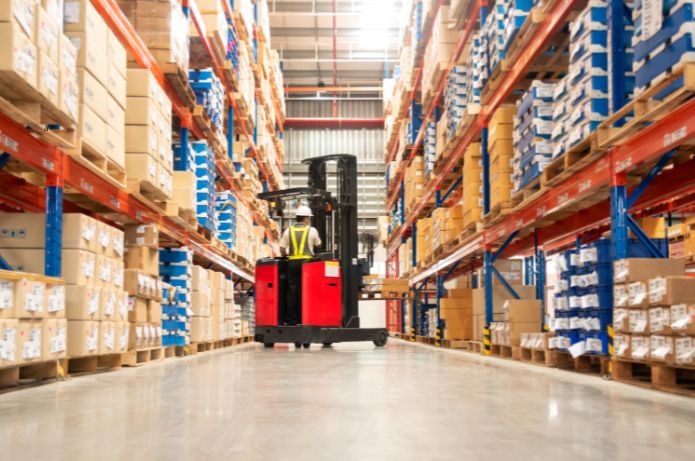
In an increasingly dynamic logistics scenario, the boundary between safety and productivity continues to be tested daily. Imagine the following scene: a forklift operator moves pallets while a worker crosses the warehouse area. An imminent collision risk arises in a fraction of seconds, forcing the operator to brake sharply, slowing down the operation's pace. Situations like this are still more frequent than they should be and reveal a persistent dilemma: how to maintain operational efficiency without compromising workplace safety?
For decades, safety and productivity were treated as conflicting objectives. Traditional measures, such as drastic speed reduction, rigid route segregation, and excessive signage, were often seen as barriers to operational fluidity. On the other hand, each accident generates not only irreparable human impacts but also significant financial costs. The numbers reinforce this reality. According to OSHA (Occupational Safety and Health Administration), forklift accidents cause approximately 34,900 serious injuries and an estimated 85 deaths per year in the United States alone.
In Brazil, it is estimated that over 15,000 accidents involving forklifts occur annually (data from ABRALOG and the Occupational Safety and Health Observatory, 2023). Beyond human losses, the National School of Public Administration (ENAP) points out that workplace accidents generate over R$ 15 billion in annual costs in the country, combining direct and indirect expenses. Technology as a convergence factor The digitalization of logistics operations has transformed safety into a performance ally. Modern solutions demonstrate that it is possible to unite productivity and protection through data, visibility, and real-time control, without compromising the operation's pace. The key differentiator lies in the precision of the technology.
By using UWB (Ultra Wideband), for example, systems like Aura can create intelligent protection zones with a range of up to 150 meters and centimeter-level precision, overcoming physical barriers like walls and pallet racks—something conventional technologies cannot deliver reliably. In practice, this translates into active safety without unnecessary interruptions: contextual alerts are triggered only when there is a real risk, avoiding operator “alert fatigue” and maintaining fluidity when the environment is safe. From data to operational efficiency The major turning point, however, occurs when safety technology begins to generate inputs for productivity.
The precise tracking of people and machines not only serves to avoid collisions but also to generate unprecedented operational intelligence. Analytical tools integrated into these systems, such as Aura Tracking, use Artificial Intelligence to transform movements into heat maps and spaghetti diagrams. This allows managers to visualize, in real time, where the highest flows occur, excessive displacements, bottlenecks, or workers outside their designated work areas. The result is evidence-based management, not assumptions. It is possible to redesign the warehouse layout, adjust workflow, and identify operational waste based on real behavioral patterns.
Companies that adopt this integrated vision, combining IoT, UWB, and AI, report consistent results, such as a reduction of up to 80% in near-misses, a decrease between 50% and 70% in unplanned stops, and an average gain of 25% in operator productivity. Furthermore, they ensure greater compliance with regulatory standards (such as NR-11 and NR-12), reinforcing ESG practices. The old dichotomy between safety and productivity is a thing of the past. Technology today proves that a safe environment is, by definition, a more productive and competitive one.
*Vitor Rocha is a marketing specialist and analyst at LogPyx. About LogPyx LogPyx is a startup specialized in technological solutions for industrial intralogistics. Headquartered in Belo Horizonte, it develops systems that integrate automation, traceability, and operational safety for yards, warehouses, and production areas. Its solutions increase process efficiency, reduce costs, and promote more organized and safer environments for people, vehicles, and assets.


 Portuguese (Brazil)
  English
  Spanish
  German
  Chinese (Hong Kong)
  Russian
  Hindi
Hindi  French
  Italian
  Japanese
  Arabic
  Chinese (Taiwan)
  Bengali
  Bulgarian
  Czech
Czech  Danish
  Greek
Greek  Finnish
  Croatian
  Hungarian
  Indonesian
  Hebrew
  Korean
  Lithuanian
  Dutch
Dutch  Norwegian
  Norwegian
  Polish
  Portuguese (Angola)
  Portuguese (Portugal)
  Romanian
  Slovak
  Slovenian
  Swedish
  Thai
Thai  Turkish
  Ukrainian
  Vietnamese