

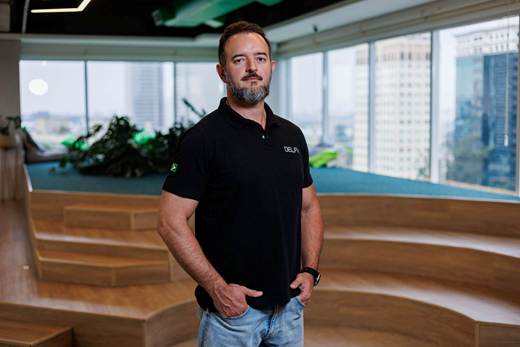
Predicting and correcting errors is an innovation that makes all the difference for companies today. Delphia, Digital journey curation performs this pioneering work, but goes beyond this function: the company has been strengthening its focus on business-oriented observability, an increasingly essential service for companies wishing to combine technical performance with the generation of real value.
With solid experience in data, infrastructure, and customer experience, Delfia argues that observability has ceased to be a technical tool and has become a results accelerator. “Today, it is possible to monitor the entire digital experience, from infrastructure to financial impact, with near real-time data and with metrics directly aligned to strategic business indicators, such as revenue, churn, and checkout time,” explains Rodrigo Bocchi, founder and president of Delfia. “Observability is the compass that transforms every byte of telemetry into a competitive advantage,” he adds.
Delfia already applies automation with over 95% confidence in tasks such as auto-scaling and automated incident remediation. The company is now in the testing phase with generative AI, capable of suggesting complete action plans based on large volumes of data and technical and business contexts, with final validation performed by humans. The goal is to evolve towards an even more intelligent and proactive model, where observability not only detects failures but also recommends the best responses to ensure business continuity.
From technical data to strategic decisions
Delfia's proposal goes beyond the traditional monitoring of “vital signs” such as CPU, memory, and logs. The company connects multiple data sources, including metrics, events, logs, traces, and product data, such as conversions and payments, to provide a unified view of the entire digital operation. This approach enables the swift detection of anomalies and the anticipation of impacts on critical KPIs, transforming technical problems into actionable business insights.
This process begins with the detailed mapping of customer journeys and the association between each transaction and the involved technical components. Telemetry is enriched with a layer of business information, including variables such as order value and user profile. With this, Delfia applies AI-powered correlation models, which enable predictive analysis of the financial impact of failures, slowdowns, or usage spikes.
The company also structures Service Catalogs and SLOs with clear visibility of metrics and responsibilities, aligning technical and business areas around shared goals. In this way, technical decisions come to be made based on measurable impacts on the business.
Results across multiple sectors
Business-oriented observability is already showing a direct impact in areas such as e-commerce, financial services, logistics, and customer experience. In retail, for example, this approach reduces checkout time and increases conversion. In the financial sector, it improves efficiency in instant payments and ensures compliance with regulations such as Open Finance. In logistics, it enables route optimization and prevents contractual penalties, while in product and CX areas, it helps correlate technical performance with NPS and customer satisfaction.
Companies from different segments are already experiencing the benefits of business-oriented observability with Delfia. Acerto, a digital debt trading fintech, for example, managed to reduce fault diagnosis time by 40%, with resolution accelerated from days to about two hours. The retail chain Havan expanded its monitoring coverage to 100% before Black Friday, drastically reducing the mean time to respond to incidents. The mobility company Localiza&Co, primarily focused on car rentals, anticipated 130 potential errors, achieving a maturity advancement of two years. And one of the country's largest higher education groups, Ânima Educação, achieved 20% savings in infrastructure, with a 60% performance improvement and a 42% contractual reduction. According to Delfia, what still prevents many organizations from adopting this approach is the absence of strong executive sponsorship and a lack of alignment between technical objectives and business goals. The company advocates actions such as including business KPIs in the daily routine of technology teams, implementing cross-functional SLOs, and investing in continuous education about the financial impact of incidents and operational inefficiencies.
The future of observability
Delfia believes that observability will be a competitive differentiator in the coming years, especially in regulated and highly digital sectors. “Companies mature in observability are up to four times more likely to exceed their financial and operational targets,” highlights Rodrigo Bocchi.
The company also notes important trends such as FinOps, SecOps, GreenOps, and real-time monitoring as pillars for the evolution of observability. In the case of fintech Zoop, for example, Delfia helped consolidate ten tools into a single solution based on Datadog, reducing costs and increasing governance. In another example, the integration between observability and security at Acerto reduced the mean time to respond to less than two hours.
With the advancement of generative AI, Open Finance, and the need for real-time decisions, Delfia prepares its clients with continuous data streaming, precise tracking of AI model performance, and permanent compliance with regulatory milestones, such as the LGPD.

