

Marketplaces and Generation Z: Which Platforms Are the "Favorites" of This Generation? Acts as a consultant with app data Experience + Digital"Start online, try in-store, receive at home"
Fragmented by channelOmnichannelExport to Spreadsheets
Strategic Benefits
Increase in Average Transaction Value Customers who shop across channels (multichannel) tend to spend up to 30% more than customers who buy only through one channel, as they have more touchpoints with the brand.Stockout Reduction
With the concept of
Endless Aisle
), the physical store never "loses the sale" due to lack of size or color, as it can sell from the e-commerce or another branch's stock.
- Sensory Experience + Data Convenience Phygital resolves the biggest pain point of e-commerce (not being able to touch/prove products) and the biggest pain point of physical retail (lack of information/reviews and checkout lines).
- Infinite Shelf (Endless Aisle) (from English
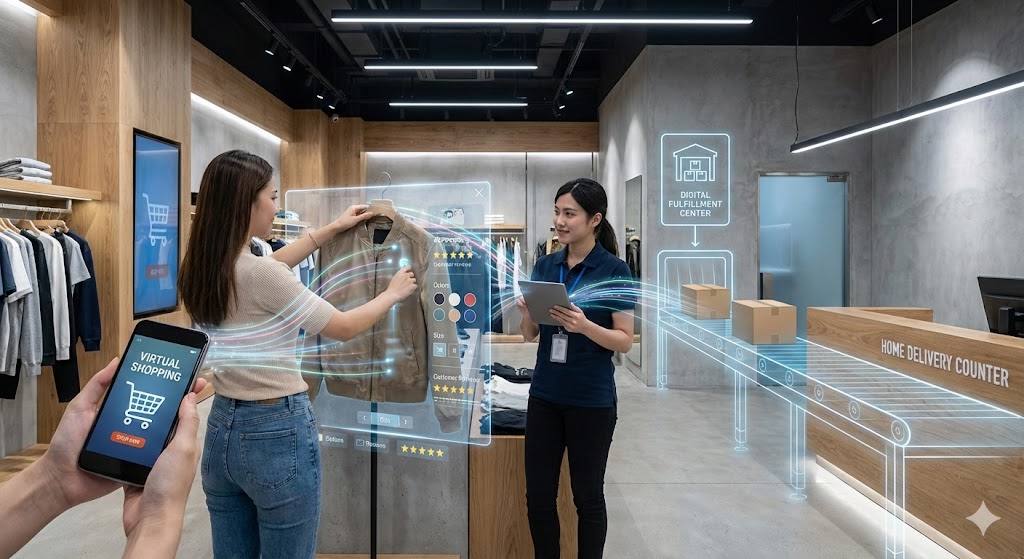
- ) is a retail strategy that integrates the physical and digital inventory of a brand to ensure the customer never leaves the store without the desired product, even if the item is not physically available at that location at the time of purchase. In practice, it involves equipping physical store sales associates with mobile devices (tablets or smartphones) or installing self-service kiosks that provide access to the entire company's inventory (e-commerce, distribution centers, or other branches). If a customer wants a shirt in size G and the store only has M, the sales associate processes the size G sale via the tablet, and the product is delivered to the customer's home.
- The Problem Solved: "Stockout" In traditional retail, stockout (lack of product on the shelf) is the main cause of lost revenue. When a customer cannot find their preferred size or color, they usually leave and purchase from a competitor.
eliminates this barrier with the concept of
"Save the Sale" (SALVAR A VENDA)
- . It transforms a frustrating experience ("We don't have your size") into a service solution ("We don't have it here, but I can arrange delivery to your home tomorrow with free shipping"). How It Works in Practice is The Demand:
- The customer finds a product in the physical store but wants a variation (color, size, voltage) that is not available in the local stock. The Inquiry:
- The sales associate accesses the Unified Commerce system via tablet/smartphone. They view the brand's "global stock." The Transaction:
Payment is made right there, at the store's payment terminal. For the customer, it's a normal in-store purchase.
| The Fulfillment (Delivery): | The system triggers the order to the e-commerce Distribution Center (or a nearby store that has the item), which ships the product directly to the customer's address ( | Customers who shop across channels (multichannel) tend to spend up to 30% more than customers who buy only through one channel, as they have more touchpoints with the brand. |
| Ship-from-DC | 1. Physical Space Optimization (Showrooming) | Stores can be smaller and less expensive, functioning as |
| Stock | . They only need to have one piece of each model for the customer to see and touch, without the need to stock full ranges of sizes in the back of the store. | 2. Increased Conversion Rate |
| Studies show that customers who interact with Infinite Shelf technologies in stores tend to have a higher average transaction value, as they have access to the complete product catalog, including exclusive website items. | 3. Customer Loyalty | It addresses the customer's immediate need, preventing them from restarting their purchasing journey elsewhere. |
| Comparison: Traditional Retail vs. Infinite Shelf | Traditional Retail | Retail with Infinite Shelf |
| Data | Customer wants size 42 shoes, store only has size 40. | Sales Associate Action |
"Sorry, out of stock. Try the other branch."
"I have it in stock at the central warehouse. I'll place the order now and it will arrive at your home."
Customer leaves frustrated (Sale Lost).
Customer pays and leaves satisfied (Sale Saved).
Limited to the store's walls.
Effectively unlimited. Endless Aisle (Hybrid logistics (pick up immediately or receive at home).Implementation Challenges
For the Infinite Shelf to work, the brand needs to overcome the challenge of
Stock Accuracy
The system needs to know exactly, in real-time, how many items exist in each channel. If the system says there is one piece in the central stock, but there isn't, the "solution" generates even greater frustration (post-sale cancellation).
Endless Aisle The revolution of AI in retail: technology as a bridge between generations Hybrid logistics (pick up immediately or receive at home).Video Commerce Boom: The Death of the Static Page and the Rise of the "Media Store"
In practice, this involves equipping physical store sales associates with mobile devices (tablets or smartphones) or installing self-service kiosks that provide access to the company's entire inventory (e-commerce, distribution centers, or other branches). If a customer wants a size L shirt and the store only has size M, the associate completes the sale for size L via the tablet, and the product is delivered to the customer's home.
The Problem It Solves: “Out-of-Stock” Issues”
In traditional retail, out-of-stock (product unavailability on the shelf) is the leading cause of revenue loss. When a customer cannot find their preferred size or color, they typically leave and purchase from a competitor.
A Endless Aisle eliminates this barrier with the concept of “Save the Sale”. It transforms a frustrating experience (“We don't have your size”) into a service-oriented solution (“We don't have it here, but I can arrange to have it delivered to your home tomorrow with free shipping”).
How It Works in Practice
The operational flow typically follows four stages:
- The Demand: A customer finds a product in the physical store but desires a variation (color, size, voltage) unavailable in the local inventory.
- The Inquiry: The sales associate accesses the Unified Commerce system via tablet/smartphone. They view the brand's “global inventory.”.
- The Transaction: Payment is processed on the spot using the physical store's card terminal. For the customer, it is a standard in-store purchase.
- The Fulfillment (Delivery): The system triggers the order to the e-commerce Distribution Center (or to a nearby store that has the item), which ships the product directly to the customer's address (Ship-from-Store stories Ship-from-DC).
"I have it in stock at the central warehouse. I'll place the order now and it will arrive at your home."
1. Physical Space Optimization (Showrooming)
Stores can be smaller and more cost-effective, functioning as showrooms. They only need to stock one unit of each model for customers to see and touch, eliminating the need to store full size runs in the back of the store.
2. Increased Conversion
Studies show that customers who interact with Endless Aisle technologies in stores tend to have a higher average ticket, as they have access to the complete product catalog, including items exclusive to the website.
3. Customer Loyalty
It immediately resolves the customer's need, preventing them from restarting their purchase journey elsewhere.
Comparison: Traditional Retail vs. Endless Aisle
| Scenery | Traditional Retail | Retail with Endless Aisle |
| Scenario | Customer wants size 42 shoes; store only has size 40. | Customer wants size 42 shoes; store only has size 40. |
| Sales Associate Action | “Sorry, we're out of stock. Try the other branch.” | “I have it in the central warehouse. I can place the order now, and it will be delivered to your home.” |
| Outcome | Customer leaves frustrated (Lost Sale). | Customer pays and leaves satisfied (Saved Sale). |
| Stock | Limited to the store's four walls. | Virtually unlimited. |
| Logistics | Customer takes the bag. | Hybrid logistics (take it now or receive it at home). |
Implementation Challenges
For the Endless Aisle to function, the brand must overcome the challenge of Inventory Accuracy. The system must know precisely, in real-time, how many items exist in each channel. If the system indicates an item is in the central stock but it is actually unavailable, the “solution” creates even greater frustration (post-sale cancellation).

