


The digital payments landscape is undergoing significant transformation. New technologies offer modern alternatives to traditional transaction methods. One such innovation combines the stability of conventional currencies with the efficiency of blockchain.
This solution enables secure and instant transactions directly within the checkout process. Brazilian consumers and businesses seek faster and more cost-effective options for their commercial operations.
The current global market context shows a growing migration toward digital assets. Major international brands and fintechs have already successfully implemented this technology. This signals an irreversible trend in the financial sector.
For the Brazilian audience, this alternative gains special relevance. Considering scenarios of inflation and exchange rate volatility, value preservation becomes crucial. Adoption brings immediate benefits such as reduced transaction costs and the elimination of intermediaries.
This introduction prepares the reader to understand the technical and operational aspects that will be detailed in the following sections. The complete guide will explore how these settlements modern settlements work and their impact on e-commerce.
Key Points
- Stablecoins offer a modern alternative to traditional payment methods
- They combine the stability of fiat currencies with the efficiency of blockchain technology
- They enable secure and instant transactions during checkout
- They reduce transaction costs and eliminate banking intermediaries
- They facilitate access to global markets without currency barriers
- Major international brands have already successfully implemented this technology
- They offer a relevant solution for the current Brazilian economic context
Introduction to the Universe of Stablecoins
Modern payment mechanisms emerge as a response to the limitations of traditional systems. They combine monetary stability with the efficiency of technology blockchain, creating practical solutions for digital transactions.
Context and current relevance
A adoption of these financial instruments is expanding beyond the crypto. universe. Fintechs and global companies now use them for international payments and financial management.
Recent regulatory frameworks establish solid foundations for this market. Structures such as the GENIUS Act in the US and MiCA in Europe require full transparency of reserves.
Global overview and vision for Brazil
J.P. Morgan research projects exponential growth for this segment. Estimates indicate a potential of US$ 500-750 billion in the short term.
For Brazil, this innovation represents a strategic opportunity. The expanding digital payments landscape creates fertile ground for new digital assets.
| Regulation | Region | Main Requirement | Current Status |
|---|---|---|---|
| GENIUS Act | United States | Transparent 1:1 reserves | Under implementation |
| MiCA | Europe | Transparency and auditing | Approved |
| BCB Guidelines | Brazil | Framework under development | Under discussion |
What Stablecoins Are and How They Work
Unlike traditional cryptocurrencies, stablecoins maintain stable value through specific mechanisms. This characteristic makes them ideal for commercial transactions and digital payments.
Definition and essential characteristics
A stablecoin is a type of cryptocurrency specifically designed to maintain value stability. It contrasts with assets like Bitcoin, known for their high volatility.
These digital tokens are pegged to reference assets, with the US dollar being the most common. Other options include the euro, gold, and various commodities.
Pegging mechanisms and reserves
The system operates with 1:1 reserves, where each token in circulation is backed by an equivalent amount in fiat currency or secure assets. This structure guarantees the possibility of immediate redemption.
When a user acquires 100 units pegged to USD, the issuer adds $100 to its reserves. Upon redemption, the money is returned and the tokens are removed from circulation.
The credibility of issuers and transparency of reserves are fundamental to maintaining trust in the system. This approach ensures that value remains stable over time.
Stablecoins no Checkout: Compre Fácil e Seguro
Blockchain technology simplifies payments through automated systems. Major e-commerce platforms have implemented native support for these digital assets.
Integration with payment platforms
Companies do not need to manage digital wallets or private keys. The payment infrastructure handles all technical complexity automatically.
Platforms like Stripe have developed complete checkout tools. Funds arrive directly in the bank account in the chosen currency.
Reports and reconciliation appear integrated into the administrative dashboard. The experience maintains the familiarity of traditional methods.
Automatic conversion and liquidity
Shopify accepts USDC through a partnership with Stripe. Conversion to fiat currency occurs in the background.
Customers experience an intuitive and familiar checkout flow. Businesses receive payments quickly without complications.
Liquidity mechanisms guarantee instant conversions. Specialized pools prevent significant price slippage.
| Platform | Supported Asset | Settlement Time | Auto-Conversion |
|---|---|---|---|
| Shopify | USDC | Instant | Yes |
| Stripe | Multiple Options | 24 Hours | Yes |
| Local Platforms | Under implementation | Variable | Partial |
Merchants can choose to hold digital assets or convert to local currency. This operational flexibility benefits businesses of all sizes.
Main Types of Stablecoins Used in Payments
The diversity of stabilization mechanisms creates different categories of digital tokens. Each type offers specific characteristics for various market uses.
Fiat-Backed Stablecoins and Their Benefits
These tokens maintain a 1:1 peg with fiat currencies like the dollar or euro. This structure guarantees immediate redemption and maximum stability.
Popular examples include USDC, USDT, and EURC. They represent approximately 99% of commercial transaction volume.
Their operational simplicity attracts merchants and consumers. Direct conversion to fiat currency eliminates technical complexities.
Diversification: Crypto-Backed, Commodity-Backed, and Algorithmic
Crypto-backed tokens operate through over-collateralization. DAI is the most well-known example in this category.
Stablecoins pegged to commodities like gold offer a hedge against inflation. PAX Gold and Tether Gold represent this class of assets..
Algorithmic versions use dynamic supply controls without physical reserves. This approach has shown significant historical vulnerabilities.
For daily payments, fiat-backed options predominate. They combine familiarity with technological efficiency.
Benefits of Using Stablecoins in Transactions
Value stability transforms the payment experience for consumers and businesses. Unlike volatile cryptocurrencies, these digital assets maintain parity with fiat currencies like the dollar.
This characteristic eliminates risks of sharp fluctuations during commercial transactions. Businesses can price products confidently, knowing the value received will remain constant.
Value Stability and Transaction Speed
Confirmations occur within seconds, operating 24/7. Traditional banking systems rely on business hours and batch processing.
This agility revolutionizes international payments.. Businesses eliminate multi-day waits for settlement across different currencies and countries.
Reduced Cost and Global Access
The reduction of intermediaries significantly cuts transaction fees. Traditional international transfers involve multiple financial institutions.
Anyone with internet access can participate in this financial ecosystem. Regions with limited banking infrastructure gain access to global markets.
Confirmed transactions are irreversible, minimizing fraudulent chargebacks. Merchants gain greater operational certainty with each sale.
Programmability allows for the creation of automated and conditional payment flows. This flexibility opens possibilities for innovative business models.
How to Integrate Stablecoins into Checkout Systems
Adopting new financial technologies involves decisions regarding operational control and technical complexity. Businesses can choose between three main implementation paths.
Integration Options: Gateways, Wallets, and Platforms
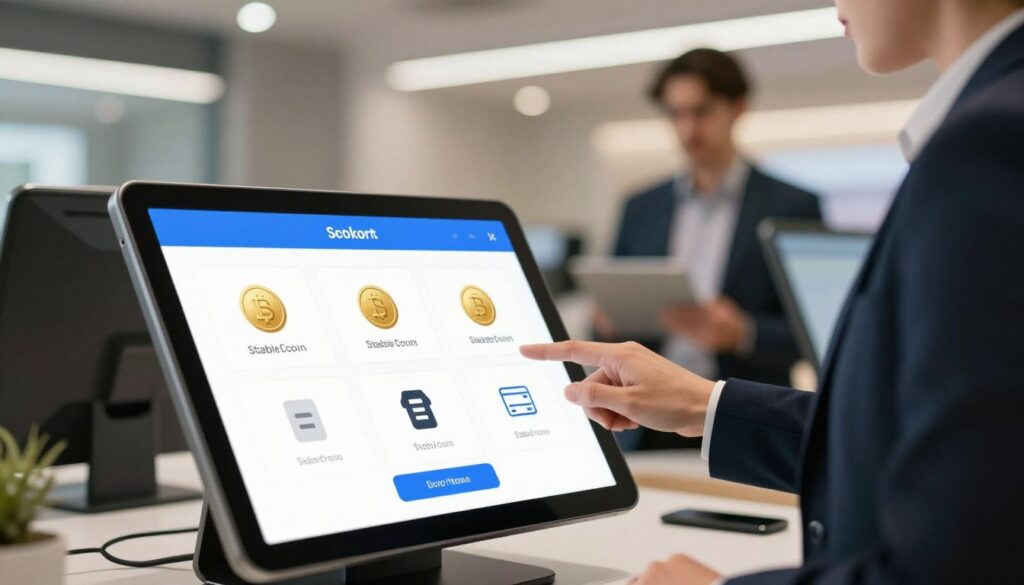
Traditional payment platforms offer native support for these digital assets. Businesses do not need to manage wallets or private keys.
Direct wallet-to-wallet payments provide full control over funds. This option requires greater responsibility for security and compliance.
Cryptocurrency-specialized gateways provide checkout widgets and POS integrations. They simplify the experience for end customers.
Technical and Operational Aspects
Strategic decisions include auto-conversion or holding digital assets. Security requires choosing between self-custody or third-party custody.
Technical infrastructure involves APIs, webhooks for confirmation, and accounting reconciliation. Existing ERP systems must integrate with the new payment flows.
Implementation ease has improved significantly in recent years. Businesses still need to define clear policies before production adoption.
Use Cases and Practical Examples
Global companies demonstrate practical applications of stable digital tokens in commercial operations. These real-world implementations show how the technology works beyond theory.
Adoption by Major Brands and Fintechs
Internationally recognized brands are already experimenting with accepting these digital assets. Gucci and Chipotle represent emblematic cases in adoption retail.
This movement signals mainstream legitimization of the technology. Fintechs build entire business models based on these solutions.
Shopify accepts USDC through a partnership with Stripe. Thousands of merchants process settlement automatically in the background.
This integration simplifies payments for businesses of all sizes. Conversion to fiat currency occurs without manual intervention.
Applications in E-commerce and Cross-Border Payments
Migrant workers use these assets to send international remittances. They avoid high fees from traditional services.
Transfers occur in minutes instead of days. This agility revolutionizes the global remittance sector.
Companies like SpaceX convert multiple currencies for unified treasury management. Multinationals experience more efficient intercompany settlements.
Em markets In emerging markets, these assets serve as a practical substitute. They offer a solution for countries with limited banking infrastructure.
Financial institutions recognize the transformative potential of this technology. The global finance sector is progressively adapting to these innovations.
Challenges and Risks in Adopting Stablecoins
While offering significant advantages, fiat-backed tokens present specific challenges that require attention. Companies must carefully evaluate these obstacles before implementation.
Concerns regarding reserves and volatility
Trust in the reserves is fundamental to the stability of these assets. When poorly managed or difficult to access, the backing can fail.
The collapse of TerraUSD demonstrated the risks involved. Companies need to verify the transparency of the reserves reserves before adoption.
“The robustness of a stablecoin depends directly on the quality of its reserves and ongoing auditing.”
Regulatory and security challenges
Each jurisdiction has distinct regulatory frameworks. Multinationals face difficulties in harmonizing regional requirements.
Security represents another critical point. Loss of private keys or phishing attacks can result in irreversible losses.
| Risk Type | Potential Impact | Mitigation Measures |
|---|---|---|
| Regulatory | Fines and suspensions | Prior legal analysis |
| Security | Total loss of funds | Professional custody |
| Reserves | Collapse of the peg | Independent audit |
Financial teams need to develop specific skills for proper management. The lack of traditional legal protections requires additional caution.
The adoption of these digital assets affects compliance, operations, and brand reputation. The technology advances, but the surrounding systems are still evolving.
Security and Regulation in Stablecoin Payments
Protection and regulatory compliance represent the essential foundations for the mass adoption of digital assets in commercial transactions. This dual approach ensures systemic stability and user trust.
Protection mechanisms on the blockchain
The stablecoin inherit the cryptographic security of the networks on which they operate. Confirmed transactions become immutable and publicly verifiable.
Companies implement multi-factor authentication and multisignature wallets. Storage on specialized hardware offers military-grade banking protection.
Programmable protocols replicate familiar card functionalities. The transparency of the blockchain blockchain allows for real-time anti-fraud monitoring.
International legislation and the landscape in Brazil
The GENIUS Act The United States requires 1:1 reserves with public monthly reports. Europe is advancing with the MiCA regulation for issuer authorization.
In Brazil, the 2022 Virtual Assets Law establishes frameworks frameworks supervised by the Central Bank. This evolution signals national regulatory maturity.
Singapore and the UK are developing their own compliance. regulatory frameworks. Global financial frameworks.
institutions are progressively adapting to these new
environments.
Comparison: Stablecoins versus Other Payment Methods
Comparing different transaction methods reveals specific advantages of each technology. This analysis helps companies choose the best solution for their needs.
Advantages over traditional systems.
Stable digital assets offer settlement in minutes, while bank transfers can take days. They operate 24/7, overcoming business hour limitations.
Credit cards involve interchange fees of 2-3%. These tokens eliminate these intermediary costs. They also reduce fraudulent chargebacks.
Compared to volatile cryptocurrencies, they maintain predictable value essential for accounting. Systems like PIX offer similar speed nationally.
However, they lack deposit insurance and established consumer protections. Card reward programs are also absent.
Integration with traditional and digital payment.
These assets do not replace but complement conventional methods. Modern platforms offer multiple options at checkout.
Companies can implement a hybrid strategy. They accept tokens for international payments and specific clients.
They maintain traditional methods for the general public. This approach maximizes reach and operational flexibility.
Efficient management of stable digital assets requires specialized tools to optimize corporate financial operations. Companies are finding technological solutions that simplify complex administrative processes.
Monitoring and control platforms
Systems for treasury management provide a consolidated view of digital positions. They integrate automatic conversion and accounting reconciliation with traditional ERPs.
Real-time dashboards monitor wallet balances and pending transactions. Automated alerts notify about suspicious movements or exceeded limits.
Institutional providers such as Coinbase Custody and Fireblocks ensure secure storage. Their solutions include insurance, multi-factor authentication, and regulatory compliance.
Compliance tools automate sanctions screening and KYC/AML. Robust APIs allow direct integration with existing payment systems.
Analytics platforms optimize liquidity strategies and transactional costs. Companies can utilize DeFi protocols for yield farming and collateralized loans.
Future Prospects for Stablecoins and the Financial Market
The global financial horizon is being reconfigured through the incorporation of stable digital assets. The year 2025 represents a crucial inflection point, marked not by abrupt disruption, but by a gradual integration and regulatory legitimization.
Instruments such as the GENIUS Act in the US and MiCA in Europe have established frameworks clear frameworks. This evolution transforms these assets from experiments into legitimate components of the system.

Innovations and emerging trends
Major financial institutions have abandoned the observer stance. Executives from banks like JPMorgan Chase and Bank of America have initiated discussions for a cooperative token project.
Transnational initiatives are also gaining strength. A consortium of nine European banks announced plans for a stablecoin euro-denominated stablecoin, with subsequent adherence from Citigroup.
A adoption Practical application replaces speculation. Visa introduced a cross-border payment program using these assets as a settlement layer, reducing processing times from days to minutes.
Central Bank Digital Currencies (CBDCs) are expected to coexist with stablecoins private stablecoins. This complementarity will create a more diverse and resilient digital monetary ecosystem.
Technical innovations include mechanisms for native yield and cross-chain. interoperability. Integration with the tokenization of real-world assets, such as real estate and commodities, significantly expands use cases.
The market The path leads toward mainstream adoption. These assets will become a standard option in checkouts e-commerce checkouts and payment applications, with a seamless user experience.
Conclusion
The evolution of payment systems advances through the practical integration of emerging technologies and established structures. These digital assets represent incremental progress in global financial infrastructure.
They combine monetary predictability with technological efficiency. Benefits include fast settlement, reduced costs, and universal access.
Challenges persist in regulation and trust in reserves. Frameworks like the GENIUS Act and MiCA establish solid foundations for safe adoption.
Banks and fintechs are converging to create unified ecosystems. This collaboration transforms experimental concepts into money functional digital.
infrastructure. The future of finance finance gradually integrates these solutions. They move value at the speed of the internet while maintaining traditional stability.

