

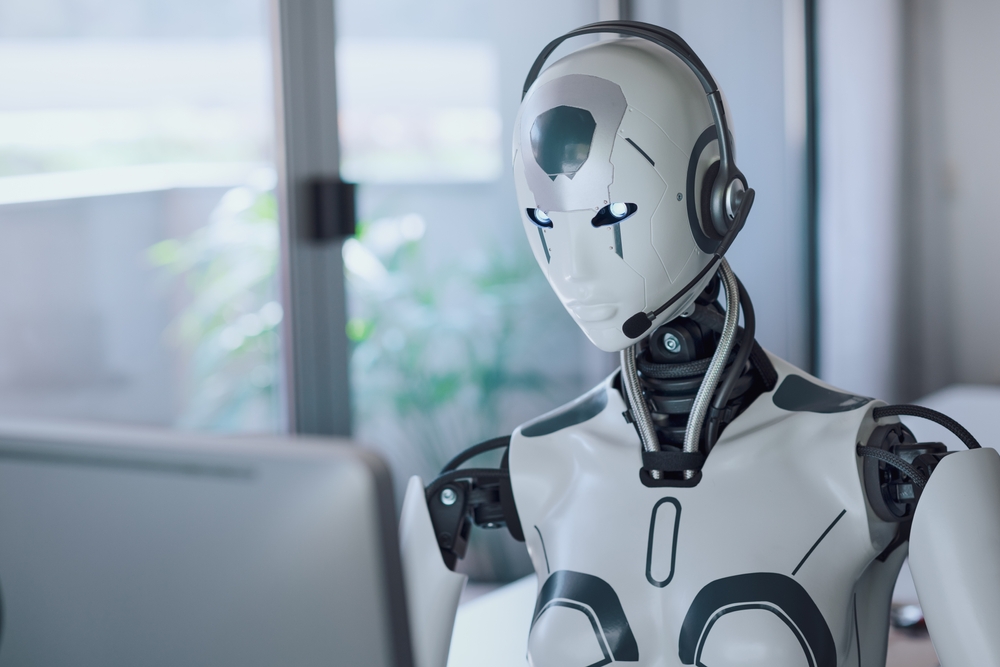
The integration between Robotic Process Automation (RPA) and Artificial Intelligence (AI) is radically changing the boundaries of enterprise automation.If before robots were restricted to simple and repetitive tasks, they now gain cognitive skills to interpret unstructured documents, make intelligent decisions and deal with complex exceptions in critical processes such as BPM processes.
In the last decade, traditional RPA has dominated automation projects, by automating repetitive and rule-based tasks, executing structured procedures tirelessly and without errors. However, by itself, RPA has limitations & TECHNOLOGY depends on well-defined inputs and does not “entende” semi-formatted or contextual information.
The arrival of AI has changed this landscape. Cognitive RPA (or Intelligent Process Automation, IPA) is the logical evolution of RPA: by integrating AI and machine learning algorithms, robots become smarter, more adaptable and able to learn.
This allows a more dynamic automation in scenarios that change constantly. However, it is important to highlight that AI alone does not solve exceptions, since misinterpretations can occur. For these cases, it is essential to integrate structured rules and the use of tools such as BPM (Business Process Management), which directs activities for human intervention in an organized way, ensuring the total management of processes, even in the face of AI failures or inconsistencies.
Unstructured data: from challenge to opportunity
Around 80% of corporate data is unstructured & this encompasses free text, images, PDF documents, voice records, emails, and more.
These contents have always been a challenge: traditional computers do not interpret them easily. The combination of RPA with AI has been solving this puzzle. Through Natural Language Processing (PLN) techniques, bots now understand and extract information from texts and emails; with computer vision and OCR algorithms, they can “ler” scanned documents, PDFs and even images, converting them into usable data.
In addition, predictive and learning models enable automated systems to make decisions based on data - for example, sorting the subject of an email and forwarding it to the correct destination, or approving transactions based on smart rules.
The practical impact is enormous. Processes that were once manual and time-consuming can now be automated end-to-end. A common example is the extraction of information from forms and invoices: Intelligent Document Processing tools use AI to read PDF fields or images and RPA throws this data into internal systems without human intervention. Similarly, emails can be read by AI, which identifies intent, language or sentiment, and can trigger automated actions via RPA. This synergy eliminates rework, reduces errors and accelerates operational cycles. Indeed, by combining RPA and AI, companies report reductions of up to 85% in the time of processing of data without being seen, certain automation are seen in the time of processing of certain processes.
Trends in technology
The convergence of RPA with AI is part of a larger trend, often called hyperautomation.This approach, highlighted by Gartner among the major technology trends in recent years, seeks to automate everything possible within an organization.
This combines RPA, AI/ML, process mining, intelligent workflow platforms and many other tools into one integrated automation track. Hyperautomation aims to quickly identify and automate end-to-end processes, going beyond the automation of isolated tasks.
Thus, pioneering companies already invest in complete automation ecosystems, in which an intelligent mechanism extracts insights from documents or big data, and triggers robots to perform subsequent actions in an orchestrated way. This movement has generated significant results in cost reduction, and increased productivity, according to industry estimates.
Another trend is the incorporation of Generative AI into automation platforms. Technologies such as advanced language models allow robots to handle even more sophisticated activities (GENerate texts, summarize long documents, extract context from conversations, and even write code to automate new tasks.
This symbiosis between RPA and generative AI points to a future in which much of the corporate workflow can be self-managed by intelligent systems, with minimal human interference in operational activities. From the point of view of market and investments, the indicators reflect the scale of this convergence. Global estimates project that the cognitive automation market will reach US$ 53 billion by 2032. Already the specific RPA market, previously restricted to flows based on fixed rules, is transforming and should reach US$ 15 billion by around 2029, driven largely by the incorporation of intelligence into robots.
Strategy, challenges and next steps
The union of these technologies brings opportunities, but also requires a clear strategic vision. One of the biggest challenges is to ensure the quality of data to train intelligent models.
Because these models directly depend on the quality of the information used in training, any inconsistency or incorrect data can drastically compromise the results of automation. Companies need to invest not only in advanced technologies, but also in rigorous strategies for data management and validation, ensuring accuracy, consistency and constant updating.
Another challenge involves aligning new automated solutions with existing technology architecture, which is often heterogeneous and composed of legacy systems that are difficult to integrate. This scenario generates additional complexity, requiring technical teams to plan in detail to avoid incompatibilities or operational failures.
In addition, properly measuring the return on investment (ROI) of these cognitive initiatives is also complex, as the benefits often exceed simple resource savings, affecting strategic areas such as customer satisfaction, operational efficiency and the companies' own innovation capacity.
For leaders, the time is now: evaluate processes, invest in pilot projects, learn from results, and scale intelligent automation responsibly.The revolution of cognitive automation it is already underway, expanding the boundaries of the possible & WHO to get ahead will surely reap the fruits of this new technological reality.

