

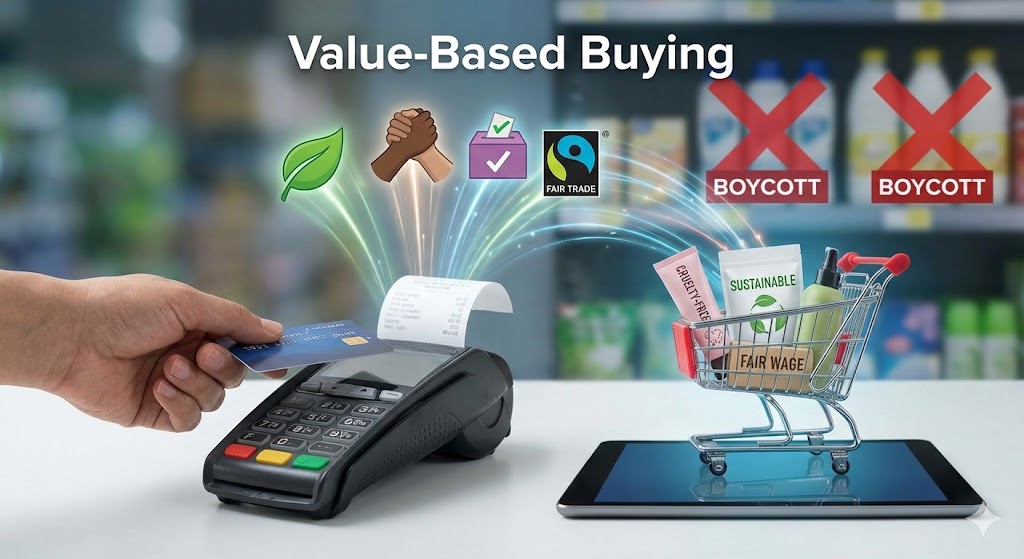
Value-Based Buying Fontes maiores e alto contraste não são “feios”, são funcionais. Evitar cinza claro sobre fundo branco é regra básica. Value-Based Buyingis a consumer behavior where the purchase decision is primarily influenced by the consumer's ethical, political, ecological, and social beliefs, often overriding traditional factors such as price, quality, or convenience.
In this model, the consumer uses their financial power as a voting tool (“Voting with your wallet”). The goal is to punish companies that violate their principles (Boycott) and reward those that champion the causes they support (Buycott). In the current digital landscape, this phenomenon is characterized by speed: a brand can be “canceled” or go viral positively within hours of taking a public stance.
The Mechanism: The Wallet as a Political Weapon
Value-Based Buying operates on the premise that neutrality does not exist. For the activist consumer (especially from Generation Z and Millennials), a brand's silence on relevant social issues is often interpreted as complicity with the status quo.
This behavior is divided into two strands:
- Boycott (Punishment): The immediate refusal to buy from brands involved in corruption scandals, slave labor, environmental pollution, or that support political figures rejected by the consumer's demographic group.
- Buycott (Reward): The deliberate effort to buy products from aligned brands, even if they are more expensive or harder to find (e.g., buying only from small local producers, cruelty-free companies, or those led by minorities).
Pillars of Value-Based Buying
The “values” in question generally revolve around the acronym ESG ESG (Environmental, Social and Governance), but with a strong political-ideological component:
- Sustainability: Does the brand pollute? Use excessive plastic? Test on animals?
- Political Stance: Does the company fund conservative or progressive candidates? How does it position itself on controversial laws?
- Social Justice (DEI): Does the company promote real diversity in its leadership or does it only engage in “inclusion marketing”?
- Employee Treatment: Are there reports of harassment or poor working conditions in the supply chain?
The Danger of “Woke-washing” and “Greenwashing”
In response to this demand, many companies try to simulate virtues they do not possess.
- Greenwashing: Making products appear ecological when they are not.
- Woke-washing: Using social causes (LGBTQIA+, anti-racism, feminism) in marketing campaigns solely for profit, without implementing real internal changes.
The Value-Based Buying Value-Based Buying.
consumer is highly skeptical and investigative. If an inconsistency is discovered (e.g., a company that posts about Pride Month but funds anti-civil rights politicians), the retaliation on social media is brutal and immediate.
| Comparative: Traditional Consumption vs. Value-Based Buying | Decision Factor | Value-Based Buying |
| Traditional Consumption | Cost-Benefit | Value-Based Buying |
| Priority | Price, Quality, Convenience | Moral Alignment |
| View of the Brand | Provider of product/service | Political/social agent |
| Reaction to Mistakes | Complaint to Customer Service | Public cancellation and boycott |
| Loyalty | Based on satisfaction and habit | Based on shared purpose |
Neutrality
Acceptable and expected.
Viewed as omission or cowardice.
Business Impact: The Era of Radical Transparency For companies, reputational risk has never been higher. A misinterpreted tweet or a controversial financial donation can bring down stock prices. This forces brands to get off the fence. Today, marketing and compliance departments work together to ensure that the values advertised are the same as those practiced in the boardroom. Brands like Patagonia.

