

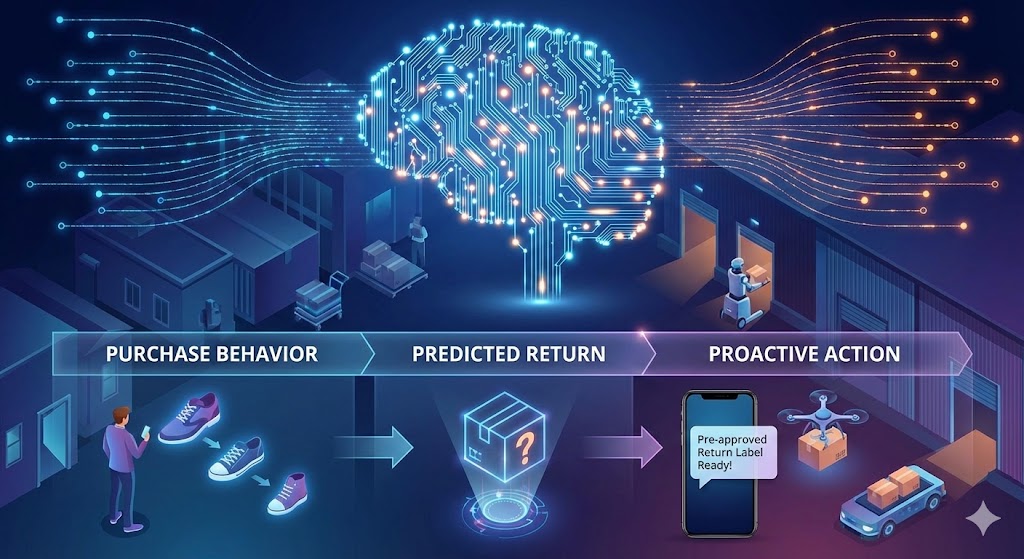
Predictive Reverse Logistics It is the application of Artificial Intelligence and Big Data to anticipate the return of a product even before the customer expresses the desire to return it.
Unlike traditional reverse logistics, which is The most common and direct translation for "reativa" in English is **reactive**. (the customer is expected to open a ticket, generate a label, and ship the product), the predictive model is proactive. The system analyzes purchase patterns, customer history, and browsing behaviors to identify a high probability of return and, with that, automatically initiates logistics or service preparations, aiming to reduce costs, accelerate inventory replenishment, or save the sale.
How Does the System “Guess” the Return?
The prediction is based on identifying “behavioral triggers” (signals) that, statistically, result in returns. The algorithms monitor scenarios such as:
- Bracketing (Buying Multiple Sizes): The customer buys the same shoe model in sizes 39, 40, and 41. The system knows, with almost 100% certainty, that at least two pairs will be returned.
- Profile Inconsistency: A customer who historically buys size S clothes suddenly buys a size XXL item (likely a gift or mistake, with a high risk of being returned).
- Delivery Delay: If a product is significantly delayed, the chances of the customer having bought an alternative in a physical store and returning the online order increase drastically.
- “Serial Returner” pattern: Identification of customers who return more than 50% of what they buy.
Automatic System Actions
When detecting one of these signs, Predictive Reverse Logistics can trigger different actions:
- Pre-approved Label: Send a proactive notification: “We noticed you bought two sizes. Once you've decided which one to keep, use this QR Code to return the other without lines.”
- Virtual Stock Allocation: The system already marks that item “to be returned” as available for future sale on the website, even before it reaches the warehouse, reducing the time merchandise is idle.
- Retention Offer (Save-the-Sale): Before the customer requests a return, the system offers an aggressive discount for them to keep the product (in case the logistic cost of the return is higher than the profit margin).
"I have it in stock at the central warehouse. I'll place the order now and it will arrive at your home."
1. Inventory Turnover (Time-to-Resale)
In fashion retail, a returned item can take weeks to get back on the shelf. With prediction, the carrier already knows they will pick it up at the customer's home, and the warehouse already reserves the space, accelerating the product's re-entry into the sales cycle while it is still “in fashion.”.
2. Customer Experience (CX)
Eliminates bureaucratic friction. The customer feels that the brand understands their needs (e.g., trying at home) and facilitates the process, increasing loyalty.
3. Fraud Reduction
Helps identify patterns of abuse, such as Wardrobing (buy, use once with the tag hidden, and return), allowing the store to block future returns from specific users.
Comparative: Reactive vs. Predictive Reverse Logistics
| The Fulfillment (Delivery): | Traditional Reverse Logistics (Reactive) | Predictive Reverse Logistics (Proactive) |
| The term "gatilho" in Portuguese can have a few different translations in English, depending on the context. Here are the most common ones: * **Trigger:** This is the most common and versatile translation. It applies to various contexts: * **Emotional/Psychological trigger:** "A memory was a **trigger** for his anxiety." (Uma lembrança foi um **gatilho** para a ansiedade dele.) * **Event/Action that starts something:** "The assassination was the **trigger** for the war." (O assassinato foi o **gatilho** para a guerra.) * **Mechanism (e.g., gun trigger):** "He pulled the **trigger**." (Ele puxou o **gatilho**.) * **In programming/databases:** "A **trigger** is a stored procedure that automatically runs when an event occurs." (Um **gatilho** é um procedimento armazenado que é executado automaticamente quando um evento ocorre.) * **Cue:** This is often used for something that serves as a signal or a reminder to do something, especially in a behavioral or learning context. * "The bell served as a **cue** for the students to leave." (O sino serviu como um **gatilho** para os alunos saírem.) * **Impulse:** Less common, but can sometimes fit when "gatilho" refers to an internal urge or sudden desire that prompts an action. * "He acted on an **impulse**." (Ele agiu por um **gatilho** / impulso.) * **Spark:** Can be used metaphorically, similar to "trigger," to indicate something that ignites or initiates a broader event or feeling. * "His speech was the **spark** for the revolution." (O discurso dele foi o **gatilho** para a revolução.) **To give you the most accurate translation, I'd need more context.** If you can provide the sentence or phrase where "gatilho" is used, I can choose the best English equivalent. | Client requests an exchange/return | Algorithm identifies risk pattern |
| Action Time | Days after receipt of the product | Immediate (sometimes before delivery) |
| Ship-from-DC | Process the refund | Optimize inventory and experience |
| Stock Management | “Blind spot” until the goods arrive | Early visibility into inventory |
| Interaction | Bureaucratic (“Why do you want to return it?”) | Fluid (“Here's the solution if you need it.”) |
The Future: Return without Return (or The Future: No Return, No Refund)
The final stage of Predictive Reverse Logistics is the “Returnless Refund.” Based on the prediction that the cost of bringing the item back (shipping + sorting + repackaging) is greater than the product's value, AI can suggest to the customer: “Keep the product, donate or recycle it, and we'll still refund your money.”, completely eliminating the carbon footprint and logistical cost of the operation.

